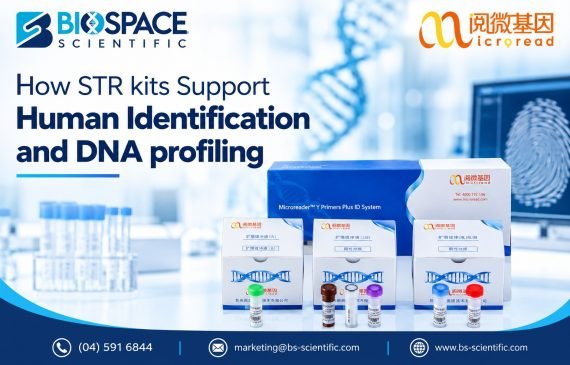
STR kits for human identification help laboratories examine specific regions of human DNA that vary among individuals. By analysing these genetic variations, forensic scientists can compare biological samples, investigate possible matches, and support evidence-based identification.
Modern forensic STR kits use multiplex polymerase chain reaction (PCR) technology to amplify multiple genetic markers in a single reaction. This approach improves workflow efficiency while supporting consistent DNA profiling.
In this article, we explore how STR technology works, its major applications, emerging laboratory trends, and how Biospace Scientific can help laboratories explore suitable molecular biology solutions.
What Are STR Kits and How Do They Work?
Short tandem repeats are short DNA sequences repeated consecutively at specific locations in the human genome. The number of repeats at a particular location, known as a locus, can vary between individuals. Analysing several STR loci creates a genetic profile that can help distinguish one person from another.
DNA profiling using STR kits typically involves the following stages:
- Sample collection: Biological evidence, such as blood, saliva, buccal swabs, or other suitable forensic stains, is collected using appropriate procedures.
- DNA extraction: Genetic material is isolated from the sample when the selected workflow requires it.
- DNA amplification: PCR amplifies selected STR markers so they can be detected and analysed.
- Genetic separation and detection: In conventional STR workflows, capillary electrophoresis separates fluorescently labelled DNA fragments according to their size.
- Profile interpretation: Specialised software and trained analysts evaluate the detected alleles, assess profile quality, and compare profiles where appropriate.
The resulting DNA profile can be compared with reference samples or evaluated against authorised forensic databases, subject to applicable procedures and regulations. The interpretation must account for sample quality, contamination risks, mixtures, and statistical significance.
The Role of STR Analysis in Forensic Science
STR analysis in forensic science is valuable because it provides a standardised method for comparing genetic information from different biological samples. Unlike examining a single genetic location, analysing multiple STR markers creates a more discriminating profile.
A well-designed STR assay can amplify numerous loci simultaneously. This multiplex approach reduces the need for separate reactions for each marker and helps laboratories manage routine and complex casework efficiently.
Forensic STR kits may be designed for different requirements, including autosomal STR analysis, Y-chromosomal STR testing, and X-chromosomal STR analysis. Autosomal markers are commonly used for individual identification, while sex-chromosome markers can provide additional information in specific kinship or forensic investigations.
Key Applications of DNA Identification Kits
DNA identification kits support a wide range of forensic and human identification activities. Their value extends beyond routine criminal investigations to situations where biological evidence can help establish identity or biological relationships.
1. Criminal investigations
DNA profiling in forensic investigations can help investigators compare DNA recovered from crime scenes with reference samples collected from known individuals. Depending on the evidence and circumstances, profile comparisons may help include or exclude a person as a potential contributor. DNA findings must be interpreted alongside other evidence rather than treated as standalone proof of guilt.
2. Missing-person investigations
STR profiling can support the identification of missing individuals by comparing available biological samples with reference samples from relatives or personal belongings. Laboratories may use additional markers and specialised kinship analysis when direct reference samples are unavailable.
3. Disaster victim identification
In incidents involving mass casualties, such as major accidents or natural disasters, DNA testing can help identify human remains. STR profiles may be compared with family reference samples to establish biological relationships and support identification procedures.
4. Paternity and kinship testing
STR markers are useful for evaluating biological relationships because genetic inheritance produces predictable patterns across generations. Laboratories can compare the profiles of related individuals and assess the statistical support for a proposed relationship.
5. Forensic DNA database comparisons
Standardised STR markers make it possible to compare profiles across eligible samples and authorised databases. Shared marker sets improve compatibility between validated laboratory workflows and relevant database requirements. Database searches and subsequent interpretations must follow applicable legal, privacy, and quality-assurance standards.
Benefits of STR Analysis for Human Identification
The benefits of STR analysis for human identification extend across laboratory accuracy, workflow efficiency, and the practical interpretation of genetic evidence.
- High discriminatory power: Examining multiple variable STR loci can help distinguish between unrelated individuals.
- Efficient multiplex testing: Multiple markers can be amplified within a single PCR reaction, reducing the need for separate tests.
- Suitability for many forensic samples: Validated assays may support testing of blood, buccal swabs, and suitable forensic stains, depending on sample condition and the kit’s specifications.
- Compatibility with established workflows: Many STR kits are designed for conventional capillary electrophoresis platforms and established forensic analysis procedures.
- Support for challenging samples: Some specialised kits incorporate features that help laboratories evaluate samples affected by degradation or PCR inhibitors.
- Standardised profile comparison: Common marker sets support comparisons between reference samples and forensic profiles when the relevant requirements are met.
However, no STR kit can guarantee a usable profile from every sample. Low DNA quantity, degradation, contamination, mixtures, and PCR inhibitors can affect the result. Appropriate validation, contamination control, quality assurance, and expert interpretation remain essential.
How Forensic Laboratories Use DNA Profiling Kits
How forensic laboratories use DNA profiling kits depends on the type of evidence, the laboratory’s testing capacity, and the purpose of the investigation. A well-planned workflow typically combines sample preparation, DNA quantification where required, STR amplification, genetic analysis, and profile interpretation.
Laboratories select forensic DNA analysis kits based on several practical considerations:
- Marker coverage: Does the kit cover the STR loci required for the intended application or database?
- Sample compatibility: Is it validated for the laboratory’s expected reference samples or forensic evidence?
- Sensitivity and robustness: Can it support reliable testing under the anticipated sample conditions?
- Quality-control features: Does it provide useful information for evaluating amplification and sample quality?
- Workflow compatibility: Can it integrate with the laboratory’s PCR instruments, genetic analysers, and analysis software?
- Validation and compliance: Does the assay meet the applicable forensic standards, validation expectations, and quality requirements?
STR typing in forensic laboratories also requires documented procedures, trained personnel, appropriate controls, and a clear chain of custody. Laboratories must distinguish reliable results from inconclusive or partial profiles and report limitations transparently.
These factors are particularly important when selecting STR kits for forensic DNA sample analysis for routine casework, reference sample processing, or specialised identification projects.
Latest Trends in STR Technology and Forensic DNA Profiling
Current developments in forensic genetics focus on improving the efficiency, quality, and interpretability of DNA testing while preserving scientific reliability.
1. Multiplex PCR and faster workflows
Multiplex amplification allows several STR markers to be tested in one reaction. Newer assay designs also aim to shorten amplification time and simplify sample processing.
2. Better assessment of sample quality
Quality-control tools are increasingly valuable when laboratories work with trace DNA, degraded evidence, or samples containing PCR inhibitors. Integrated controls can help analysts determine whether amplification succeeded and whether further processing or testing may be necessary.
3. Laboratory automation and higher throughput
Automation of sample preparation and PCR setup can reduce repetitive manual work, improve workflow consistency, and help laboratories process larger numbers of reference samples. Integrated workflows are particularly useful for DNA database operations and laboratories managing high sample volumes.
4. Greater use of complementary genetic technologies
STR profiling remains a core approach for human identification, while massively parallel sequencing and other advanced methods can provide additional information in selected cases. Sequencing may help resolve certain differences between STR alleles that have the same fragment length or support specialised analysis of complex samples. These approaches require appropriate validation and are not a universal replacement for established STR methods.
5. Stronger quality assurance and contamination control
Laboratories increasingly prioritise validated methods, forensic-grade consumables, documented procedures, and traceable sample handling. Standards such as ISO 18385 address the minimisation of human DNA contamination in products used for forensic DNA analysis. Selecting appropriate kits and consumables is therefore an important part of a broader quality-management strategy.
Together, these developments are helping laboratories build more efficient and dependable workflows without compromising the careful interpretation that forensic DNA evidence demands.
How Biospace Scientific Helps
Biospace Scientific supports laboratories and research organisations by helping them explore scientific products and laboratory solutions suited to their testing and research requirements. For organisations working in molecular biology, biotechnology, and life sciences, choosing appropriate products is an important step towards establishing dependable laboratory workflows.
When evaluating DNA testing for human identification or related molecular biology applications, laboratories should consider their intended use, sample types, testing platforms, quality requirements, and applicable validation standards.
Biospace Scientific can help customers explore relevant laboratory product options and identify solutions aligned with their operational needs. Key considerations include:
Product selection support: Helping laboratories identify relevant molecular biology products based on their application and technical requirements.
Workflow considerations: Supporting discussions about the compatibility of laboratory products with existing processes and equipment.
Quality-focused purchasing: Encouraging consideration of product specifications, documentation, quality controls, and intended-use requirements.
Research and laboratory solutions: Helping research teams explore suitable scientific products for their broader laboratory requirements.
For forensic applications, laboratories should confirm that any selected STR assay is specifically suitable for the intended human identification purpose and meets relevant validation, accreditation, and regulatory requirements. Product availability and technical compatibility should also be confirmed before procurement.
By focusing on suitable scientific solutions and informed product selection, Biospace Scientific aims to support laboratories in developing effective workflows for molecular biology and related research applications.
Conclusion
STR technology continues to play an important role in modern forensic science by enabling the analysis of genetic markers for human identification, kinship testing, missing-person investigations, and forensic casework. Multiplex PCR, improved sample-quality assessment, workflow automation, and advances in genetic analysis are creating opportunities for laboratories to improve efficiency while maintaining rigorous scientific standards.
Selecting appropriate STR kits for human identification involves more than comparing marker counts or amplification times. Laboratories must consider sample quality, assay validation, instrument compatibility, quality assurance, and the intended application to ensure that DNA profiles can be interpreted responsibly.
Biospace Scientific can help laboratories explore relevant scientific products and laboratory solutions based on their requirements.
Looking for suitable molecular biology and laboratory solutions? Contact Biospace Scientific to discuss your product requirements and explore options for your laboratory.