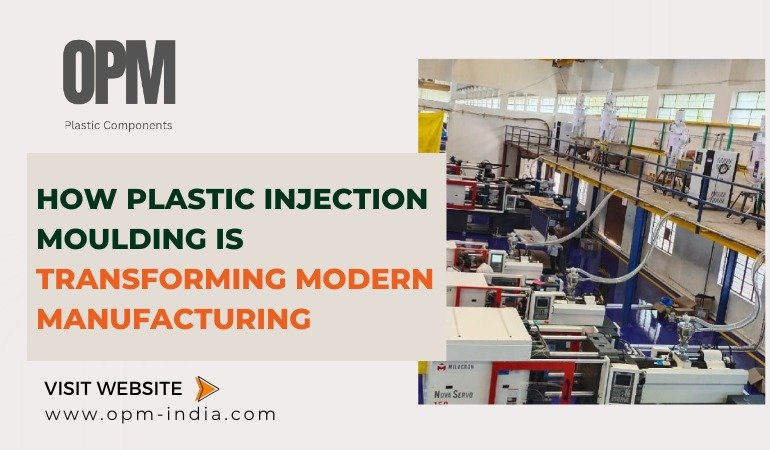
Modern industries demand speed, precision, cost-efficiency, and consistent product quality. From automotive components to household products and industrial tools, manufacturers are constantly looking for smarter production methods. One technology that has revolutionized production processes worldwide is Plastic Injection Moulding. It has become the backbone of mass manufacturing because of its ability to create complex plastic parts quickly, accurately, and affordably.
Today, Plastic Injection Moulding is widely used across sectors such as automotive, healthcare, electronics, packaging, agriculture, and consumer goods. Businesses looking for durable and customized products increasingly rely on Plastic Injection Molding for Custom Parts to meet specific design and performance needs.
What is Plastic Injection Moulding?
Plastic injection moulding is a manufacturing process where molten plastic material is injected into a specially designed mould cavity under high pressure. Once cooled and hardened, the mould opens, and the finished part is ejected.
This method is ideal for producing parts in large quantities with high consistency. Whether it is a small electronic housing or a complex automotive dashboard component, injection moulding ensures accuracy and repeatability.
Why Plastic Injection Moulding is Essential in Modern Manufacturing?
1. High-Speed Mass Production
One of the biggest advantages of Plastic Injection Moulding is its speed. Once the mould is created and the machine is set up, thousands of identical parts can be produced rapidly.
This makes it perfect for industries that require large production volumes such as packaging, consumer goods, and automotive manufacturing.
2. Exceptional Precision and Consistency
Modern industries require products with exact dimensions and flawless finishes. Plastic injection molding machines use advanced technology to maintain consistent pressure, temperature, and cycle time, ensuring each part meets quality standards.
This precision is especially valuable in sectors such as medical devices and electronics, where even minor variations can affect performance.
3. Cost-Effective Manufacturing
Although initial mould creation requires investment, long-term production costs are low. Once the mould is ready, the cost per unit decreases significantly with higher production volumes.
This is why businesses often choose Plastic Injection Molding for Custom Parts when they need large-scale production with controlled costs.
4. Ability to Create Complex Designs
Modern products often require intricate shapes, clips, threads, curves, and lightweight structures. Traditional manufacturing methods may struggle with such complexity.
With smart Injection Molding Design, manufacturers can create highly detailed parts with excellent structural integrity in a single production cycle.
Industries Benefiting from Plastic Injection Moulding
a) Automotive Industry
Automotive manufacturers use plastic parts for dashboards, bumpers, handles, trims, engine covers, and interior panels. Plastic components help reduce vehicle weight, improve fuel efficiency, and lower production costs.
b) Electronics Industry
Plastic injection moulding is used for mobile covers, appliance housings, switches, connectors, and protective casings.
c) Healthcare Industry
Medical trays, syringes, containers, and precision medical components are commonly manufactured using this process due to its hygiene and consistency.
d) Consumer Goods
Toys, kitchenware, furniture accessories, storage products, and daily-use items are made through Plastic Injection Moulding.
Importance of Injection Molding Design
A successful product starts with proper Injection Molding Design. The design stage determines functionality, material flow, wall thickness, cooling efficiency, and mould durability.
Good mould design offers:
- Reduced production defects
- Faster cycle times
- Lower material wastage
- Better surface finish
- Stronger final product
Modern CAD and simulation tools help engineers optimize mould design before production begins, saving time and cost.