Table of Contents
- Introduction
- What is Automation in Plastic Injection Molding?
- Common Automation Technologies
- 7 Ways Automation Improves Efficiency in Plastic Injection Molding
- How OPM Helps
- Conclusion
In today’s competitive manufacturing industry, automation has become an important factor in improving productivity, maintaining consistent quality, and reducing operational costs. Plastic Injection Moulding is widely used to manufacture precision plastic components for industries such as automotive, electronics, electrical appliances, furniture, and material handling. As production requirements continue to grow, manufacturers are increasingly adopting automated technologies to improve efficiency and meet customer expectations.
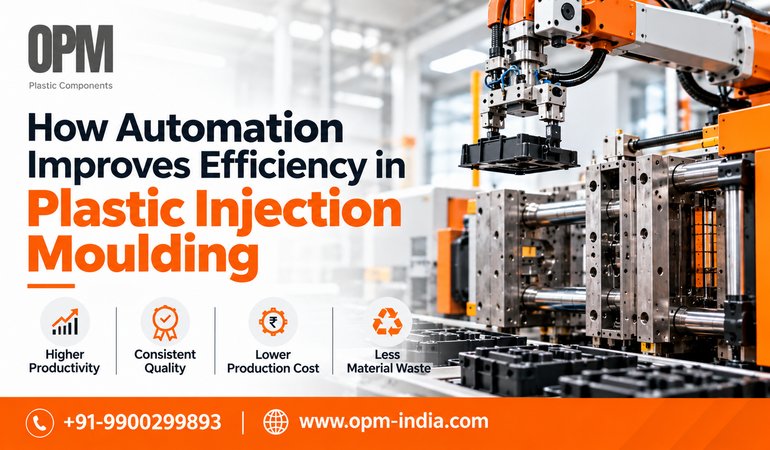
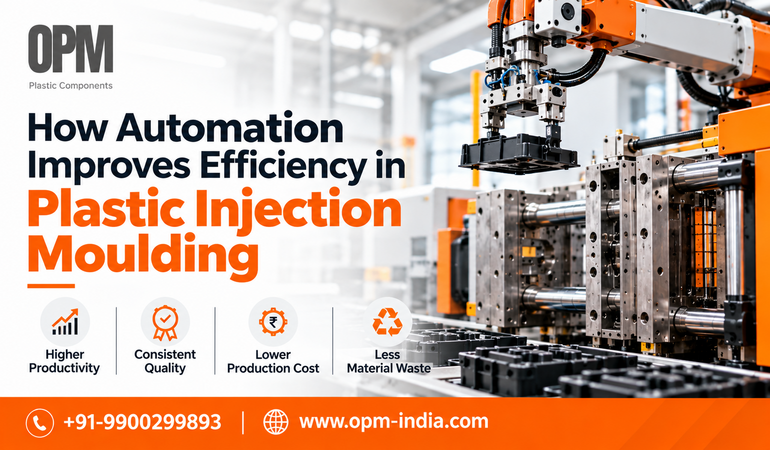
Automation in plastic injection moulding involves integrating robotic systems, automated material handling, sensors, process monitoring, and quality inspection technologies into the production process. These technologies help manufacturers reduce manual intervention, minimise errors, and achieve consistent production results.
For businesses looking for reliable Plastic Injection Moulding companies in Pune and across India, automation plays an important role in identifying manufacturing partners capable of delivering quality products, efficient production, and dependable supply.
What Is Automation in Plastic Injection Moulding?
Automation in plastic injection moulding refers to the use of machinery, robotics, and digital control systems to perform repetitive manufacturing tasks with minimal manual intervention.
Traditional moulding processes often require operators to handle activities such as removing finished components, inspecting products, moving materials, and managing production cycles. Automated systems can perform many of these activities faster and more consistently.
Common automation technologies used in plastic injection moulding include:
Common Automation Technologies
- Robotic part removal: Robots remove moulded components from the machine safely and consistently.
- Automated material handling: Systems transport raw materials and finished components efficiently.
- Process monitoring: Sensors monitor important parameters such as temperature, pressure, and cycle time.
- Automated quality inspection: Vision systems and sensors help identify visible defects and dimensional variations.
- Automated packaging and sorting: Components are counted, sorted, and prepared for further processing or dispatch.
When implemented correctly, these technologies improve production efficiency while supporting consistent manufacturing standards.
7 Ways Automation Improves Efficiency in Plastic Injection Moulding
1. Increases Production Speed
One of the most significant advantages of automation is faster production. Robots can remove finished components from moulds and transfer them to designated locations without waiting for manual handling.
Automated material feeding and component handling also help reduce unnecessary delays between production cycles. This allows manufacturers to maintain smoother workflows and improve machine utilisation.
For high-volume manufacturing operations, even small improvements in cycle time can result in substantial productivity gains over thousands of production cycles.
2. Improves Product Quality and Consistency
Maintaining consistent product quality is essential in plastic injection moulding, particularly for components used in automotive, electrical, and electronic applications.
Automation helps control repetitive operations and reduces variations caused by manual handling. Process monitoring systems can track critical production parameters and alert operators when values move outside defined limits.
Automated inspection technologies can also identify certain defects, such as surface imperfections, missing features, or dimensional inconsistencies, depending on the inspection system.
This helps manufacturers identify problems earlier, reduce defective output, and maintain consistent product standards.
3. Reduces Manufacturing Costs
Automation can help reduce manufacturing costs by improving resource utilisation and minimising avoidable waste.
Automated systems reduce the need for repetitive manual handling and can help lower expenses associated with rework, rejected components, and production interruptions. More consistent cycle times also support better production planning.
Although automation requires an initial investment in equipment, integration, and maintenance, the long-term benefits can make it a valuable investment for suitable production volumes and applications.
Manufacturers should evaluate automation based on total operating costs, expected production demand, maintenance requirements, and return on investment.
4. Minimises Human Error
Manual operations can introduce inconsistencies during component removal, sorting, inspection, and packaging. Automation reduces the number of repetitive tasks performed manually and improves process repeatability.
For example, robotic part removal can help prevent improper handling of newly moulded components. Automated counting and sorting can also reduce mix-ups between different product types.
However, automation does not eliminate every possible error. Proper machine programming, preventive maintenance, operator training, and regular quality checks remain essential for reliable production.
5. Improves Workplace Safety
Plastic injection moulding involves high temperatures, moving machinery, and potentially hazardous production areas. Automation can reduce the need for operators to perform repetitive tasks near moving machine components.
Robots, safety guards, interlocks, and appropriate safety systems help establish safer working conditions when correctly designed and maintained.
Automation also allows skilled employees to focus on machine supervision, quality management, process optimisation, and other value-added activities.
6. Enables Better Production Monitoring
Modern automation systems can collect production data, including cycle times, machine downtime, process parameters, and output quantities.
Manufacturers can use this information to identify recurring production problems, plan maintenance, and improve equipment utilisation. Monitoring systems may also provide alerts when production performance deviates from established targets.
Data-driven decision-making helps manufacturers understand where efficiency improvements are needed instead of relying only on manual observations.
7. Supports Scalable Manufacturing
As customer demand increases, manufacturers need production systems that can accommodate higher volumes without compromising quality.
Automated material handling, robotic operations, and standardised inspection processes can support more predictable production and easier workflow planning.
Automation can also help manufacturers manage multiple product variants when systems are designed for appropriate changeovers and flexible production requirements.
For growing businesses, scalable automation supports long-term manufacturing efficiency and helps meet changing customer requirements.
Key Applications of Automation Across Industries
Automation in plastic injection moulding is useful across several industrial sectors.
- Automotive: Production of interior trims, covers, housings, clips, and other plastic components.
- Electrical appliances: Manufacturing of switches, appliance housings, knobs, and protective covers.
- Electronics: Production of enclosures, connectors, and precision plastic parts.
- Furniture: Manufacturing of plastic fittings, handles, supports, and accessories.
- Household products: Efficient production of everyday plastic components and consumer goods.
- Material handling and storage: Manufacturing of plastic containers, bins, and related components.
The level of automation required depends on the product design, material, component dimensions, quality specifications, and expected production volume.
How to Choose the Right Plastic Injection Moulding Solution
Selecting the right manufacturing partner is essential for achieving the full benefits of automation. Businesses evaluating Plastic Injection Moulding companies in India should consider several important factors.
Manufacturing capabilities: Evaluate the company’s machinery, moulding capacity, tooling capabilities, and ability to handle the required component specifications.
Quality management: Look for established inspection procedures, process controls, and traceability practices appropriate to the application.
Automation capabilities: Understand how the manufacturer uses robotics, material handling systems, and production monitoring to improve consistency and efficiency.
Industry experience: Relevant experience in automotive, electrical, electronics, or other target industries can help ensure that product requirements are understood.
Scalability and delivery: Assess the manufacturer’s ability to manage production volumes, maintain schedules, and support future demand.
Businesses researching Plastic Injection Moulding companies in Pune, including the Best Plastic Injection Moulding companies in Pune, should evaluate these factors alongside technical suitability, pricing, communication, and long-term reliability.
Similarly, companies searching for Plastic Injection Mould Manufacturers in Pune or the Top Plastic Molding Companies in Pune should prioritise manufacturing capability and product quality rather than selecting a supplier based on price alone.