Different Types of MRI Scans and Their Uses: A Complete Guide
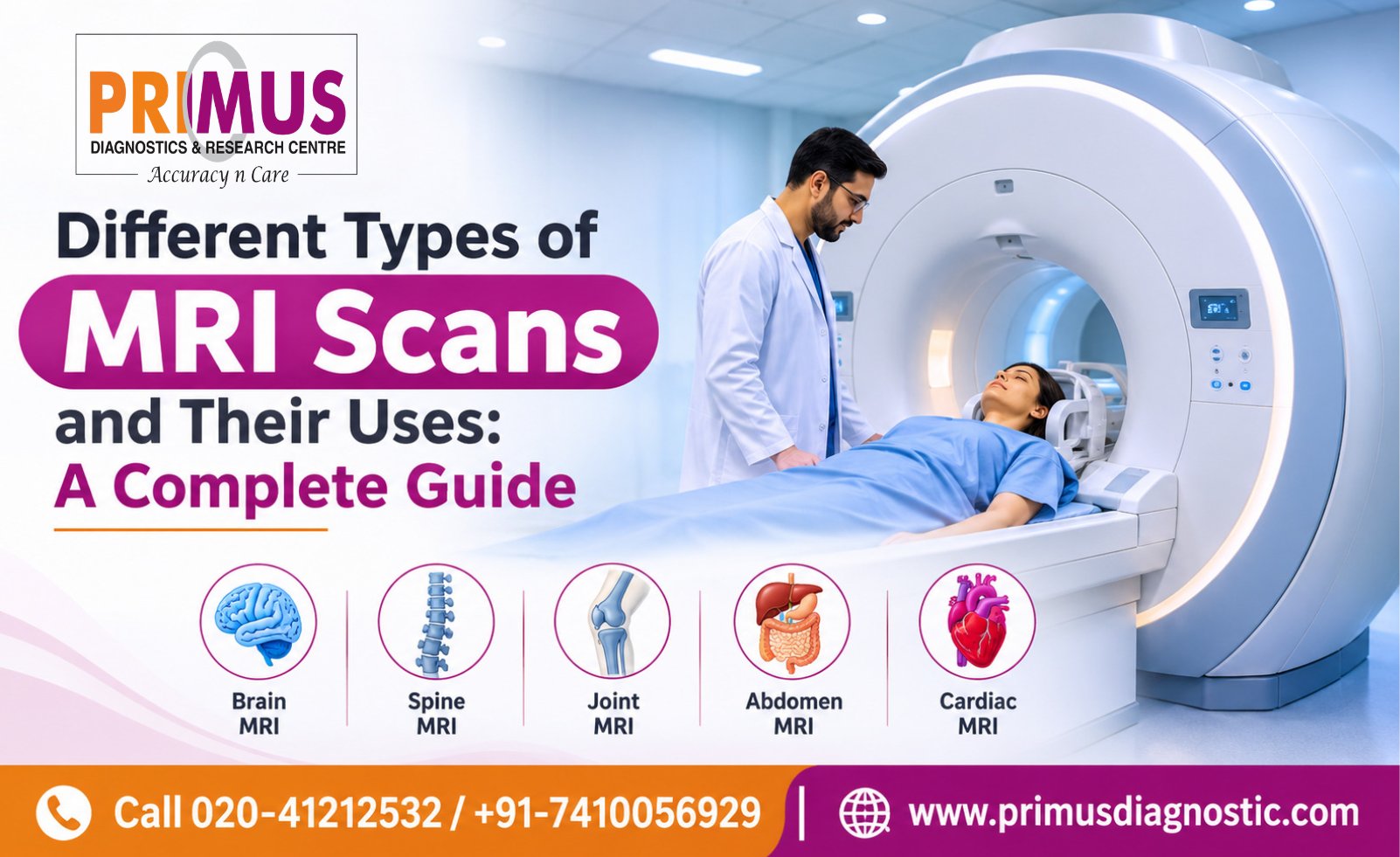

Table of Contents
- What Are the Different Types of MRI Scans?
- Different Types of MRI Scans Based on Technique
- How to Prepare for an MRI Scan?
- How to Choose an MRI Scan Centre in Yerawada, Pune?
- How Primus Diagnostics Helps
- Conclusion
Magnetic Resonance Imaging (MRI) is one of the most advanced diagnostic imaging techniques used in modern healthcare. It helps doctors examine internal organs, bones, joints, muscles, the brain, and other soft tissues through detailed images. MRI technology uses strong magnetic fields and radio waves to produce images without using ionizing radiation.
Doctors recommend different types of MRI scans depending on a patient's symptoms, medical history, and diagnostic requirements. From brain and spine MRI to knee, shoulder, abdomen, and pelvic MRI, each examination helps evaluate specific parts of the body.
If you are searching for an MRI scan centre in Yerawada, Pune, understanding the different types of MRI examinations can help you become more familiar with the diagnostic process.
In this guide, we will explore the different types of MRI scans, their uses, preparation guidelines, and how to choose an appropriate diagnostic centre in Pune.
What Are the Different Types of MRI Scans?
MRI examinations are designed to examine specific body parts and identify abnormalities that may require further medical evaluation. The type of scan depends on the area being investigated and the doctor's recommendation.
Here are some commonly performed MRI examinations.
- MRI Brain Scan
An MRI brain scan produces detailed images of the brain and surrounding structures. It helps doctors investigate neurological symptoms and evaluate abnormalities affecting the brain.
Common uses of an MRI brain scan:
- Evaluation of suspected brain tumours.
- Investigation of persistent headaches and unexplained neurological symptoms.
- Assessment of stroke-related changes.
- Examination of certain brain infections and inflammatory conditions.
- Evaluation of seizures and epilepsy.
- Investigation of memory-related and other neurological problems.
An MRI brain scan may be recommended when detailed imaging of the brain is required to support a diagnosis.
- MRI Spine Scan
An MRI spine scan examines the spinal cord, vertebrae, intervertebral discs, nerves, and surrounding soft tissues. It is commonly recommended for patients experiencing persistent back pain, neck pain, or symptoms associated with nerve compression.
MRI spine examinations are generally classified into three categories.
Cervical Spine MRI
This scan examines the neck region of the spine.
Common uses include:
- Evaluation of cervical disc problems.
- Assessment of nerve compression.
- Investigation of neck pain.
- Examination of spinal cord abnormalities.
Thoracic Spine MRI
This scan examines the middle portion of the spine.
Common uses include:
- Evaluation of thoracic disc abnormalities.
- Assessment of spinal cord conditions.
- Investigation of certain causes of upper and middle back pain.
- Examination of spinal injuries.
Lumbar Spine MRI
This scan examines the lower back region.
Common uses include:
- Detection and assessment of herniated discs.
- Evaluation of sciatica and nerve compression.
- Investigation of spinal stenosis.
- Assessment of persistent lower back pain.
- MRI Knee Scan
An MRI knee scan provides detailed images of the knee joint, including cartilage, ligaments, tendons, muscles, and surrounding soft tissues.
It is particularly useful for evaluating sports injuries, joint problems, and unexplained knee pain.
Common uses of an MRI knee scan:
- Assessment of ACL and PCL injuries.
- Detection of meniscus tears.
- Evaluation of cartilage damage.
- Investigation of ligament and tendon injuries.
Doctors may recommend an MRI knee examination when additional information about the knee joint is needed.
- MRI Shoulder Scan
An MRI shoulder scan examines the shoulder joint, rotator cuff muscles, tendons, ligaments, and surrounding soft tissues.
It helps doctors investigate injuries, persistent shoulder pain, and restricted movement.
Common uses of an MRI shoulder scan:
- Detection of rotator cuff tears.
- Evaluation of shoulder ligament injuries.
- Assessment of tendon inflammation.
- Investigation of joint abnormalities.
- Examination of certain soft-tissue injuries.
- Evaluation of persistent shoulder discomfort.
This scan may be recommended following sports injuries, accidents, or repetitive physical activities.
- MRI Abdomen Scan
An MRI abdomen scan produces detailed images of abdominal organs and surrounding tissues. It helps doctors investigate abnormalities affecting specific internal organs.
Common uses of an MRI abdomen scan:
- Examination of the liver.
- Evaluation of the kidneys and adrenal glands.
- Assessment of the pancreas.
- Investigation of certain abdominal masses.
- Evaluation of bile ducts.
- Further characterisation of abnormalities identified through other imaging tests.
The doctor determines the appropriate MRI protocol depending on the organ or condition being investigated.
- MRI Pelvis Scan
An MRI pelvis scan examines organs, muscles, bones, and soft tissues within the pelvic region. It may be recommended for both men and women when detailed pelvic imaging is required.
Common uses of an MRI pelvis scan:
- Evaluation of uterine fibroids.
- Assessment of ovarian abnormalities.
- Examination of prostate-related conditions.
- Investigation of pelvic masses.
- Evaluation of certain reproductive system conditions.
- Assessment of pelvic muscles and surrounding tissues.
MRI pelvis imaging provides detailed information that can support further medical evaluation.
- MRI Cardiac Scan
A cardiac MRI is a specialised imaging examination that produces detailed images of the heart, including its chambers, muscles, and surrounding structures.
Common uses of cardiac MRI:
- Assessment of heart muscle diseases.
- Evaluation of heart muscle damage.
- Investigation of certain congenital heart conditions.
- Assessment of inflammation affecting the heart.
- Evaluation of heart structure and function.
A cardiac MRI may be recommended by a cardiologist when detailed imaging of the heart is necessary.
- MRI Breast Scan
A breast MRI is a specialised examination that uses magnetic fields and radio waves to create detailed images of breast tissue.
It may be recommended alongside mammography or ultrasound for selected patients.
Common uses of breast MRI:
- Further evaluation of certain breast abnormalities.
- Assessment of the extent of diagnosed breast cancer.
- Screening of selected high-risk individuals.
- Evaluation of breast implants.
- Monitoring treatment response in certain cases.
The need for a breast MRI depends on individual risk factors and the treating doctor's recommendation.
- MR Angiography (MRA)
Magnetic Resonance Angiography, commonly known as MRA, is a specialised MRI technique used to examine blood vessels.
It helps doctors evaluate blood flow and investigate certain vascular abnormalities.
Common uses of MR Angiography:
- Evaluation of blood vessel narrowing.
- Detection and assessment of certain aneurysms.
- Examination of blood vessel abnormalities.
- Evaluation of selected vascular conditions.
- Assessment of blood flow in specific body regions.
Depending on the examination, MRA may be performed with or without contrast material.
Different Types of MRI Scans Based on Technique
Apart from the body part being examined, MRI scans can also be classified according to the imaging technique used.
- MRI Without Contrast
A non-contrast MRI scan is performed without injecting a contrast agent into the bloodstream. It is commonly used to examine the brain, spine, joints, and several other body structures.
- MRI With Contrast
A contrast-enhanced MRI uses a contrast agent, commonly gadolinium-based, to make certain tissues, blood vessels, and abnormalities more visible.
Doctors may recommend contrast-enhanced MRI for:
- Evaluation of certain tumours and abnormal growths.
- Investigation of inflammation and infections.
- Assessment of blood vessel abnormalities.
- Examination of selected brain and spinal conditions.
- Evaluation of certain organ-related abnormalities.
Patients should inform the medical team about kidney problems, allergies, previous contrast reactions, and other relevant medical history.
- Functional MRI (fMRI)
Functional MRI is a specialised technique that measures changes associated with blood flow in the brain. It helps study brain activity and identify areas associated with specific functions.
It is used in selected neurological evaluations and pre-surgical planning.
How to Prepare for an MRI Scan?
Following the recommended preparation instructions can help make your MRI examination smoother and more comfortable.
Here are some general guidelines:
- Follow the instructions: Follow the preparation guidelines provided by your doctor or diagnostic centre.
- Share your medical history: Inform the medical team about existing medical conditions, allergies, kidney problems, and previous surgeries.
- Mention medical implants: Inform the staff if you have a pacemaker, cochlear implant, metal implant, or any other implanted medical device.
- Remove metal objects: Remove jewellery, watches, hairpins, and other metal accessories before entering the MRI room.
- Discuss contrast requirements: If contrast is required, follow the specific instructions provided by the medical team.
- Remain still: Avoid movement during the examination to help produce clear images.
Preparation requirements may vary depending on the type of MRI examination.
How to Choose an MRI Scan Centre in Yerawada, Pune?
Choosing an appropriate diagnostic centre is an important part of the medical imaging process. Before selecting an MRI scan centre in Yerawada, Pune, consider the following factors:
- Imaging facilities: Check whether the centre offers the MRI examination recommended by your doctor.
- Qualified professionals: Consider the experience and expertise of the radiology team.
- Patient care: Look for a centre that provides clear instructions and assistance throughout the examination.
- Appointment convenience: Check appointment availability and examination timings.
- Reporting process: Understand the expected reporting time and how reports will be shared.
- Location accessibility: Choose a conveniently located centre, particularly if you need to travel from nearby areas.
These factors can help you make a more informed decision when selecting a diagnostic centre for your imaging requirements.
How Primus Diagnostics Helps
When looking for an MRI scan in Yerawada, Pune, choosing a diagnostic centre that focuses on imaging services, patient care, and convenience is important.
Primus Diagnostics & Research Centre is located in Yerawada, Pune, and serves patients from Yerawada and surrounding areas, including Viman Nagar, Kharadi, and nearby localities.
Primus Diagnostics offers diagnostic imaging services, including:
MRI Scan
MRI imaging helps doctors examine different body structures, including the brain, spine, joints, and soft tissues, depending on the available examination protocols and clinical requirements.
CT Scan
CT imaging provides detailed cross-sectional images of internal body structures and supports the evaluation of various medical conditions.
Digital X-Ray
Digital X-Ray imaging helps examine bones and other structures and is commonly used to investigate injuries and certain medical conditions.
At Primus Diagnostics, the focus is on supporting patients and referring doctors through diagnostic imaging services and a patient-friendly experience.
If your doctor has recommended an MRI examination, contact our team to enquire about the required scan, availability, preparation instructions, and appointment details.
Conclusion
MRI scans play an important role in modern medical diagnosis by providing detailed images of different body parts without using ionising radiation. From brain and spine MRI to knee, shoulder, abdomen, pelvis, and cardiac MRI, each examination serves a specific diagnostic purpose.
The right type of MRI scan depends on your symptoms, medical history, and your doctor's recommendation.
If you are searching for an MRI scan centre in Yerawada, Pune, consider factors such as imaging facilities, patient care, reporting services, and convenient location before making your decision.
Primus Diagnostics & Research Centre, located in Yerawada, Pune, provides diagnostic imaging services for patients from Yerawada, Viman Nagar, Kharadi, and nearby areas.
Centre for diagnostic imaging services with a focus on accuracy, patient care, and convenience.
If your doctor has recommended an MRI examination, get in touch with our team to enquire about scan availability and appointments.
What's Your Reaction?